If you have been browsing off plan properties for sale in Dubai, you have probably seen two very different stories. One says off-plan is the smartest way to buy, with low entry prices and easy payment plans. The other says it is a gamble best avoided. The truth sits somewhere in the middle, and it depends heavily on the project, the developer, and your own situation.
This guide lays out both sides fairly, so you can decide with clear eyes. It comes from Takween Aldar, a RERA-registered real estate agency in Dubai (ORN 52576, DLD Trade License No. 1512704) with over 12 years of experience helping buyers and investors in this market. We will pair every reward with its catch, and every risk with a practical way to manage it.
Why Off-Plan Attracts So Much Attention in Dubai
Off-plan is not a niche corner of the market here. Dubai Land Department data reported for the first half of 2026 shows roughly 58,840 off-plan sales transactions out of about 86,000 total sales deals, which means around two in every three sales were off-plan.
That popularity comes from real advantages, but popularity is not the same as suitability. A product that works well for one buyer can be a poor fit for another, so it is worth looking at what you are actually signing up for.
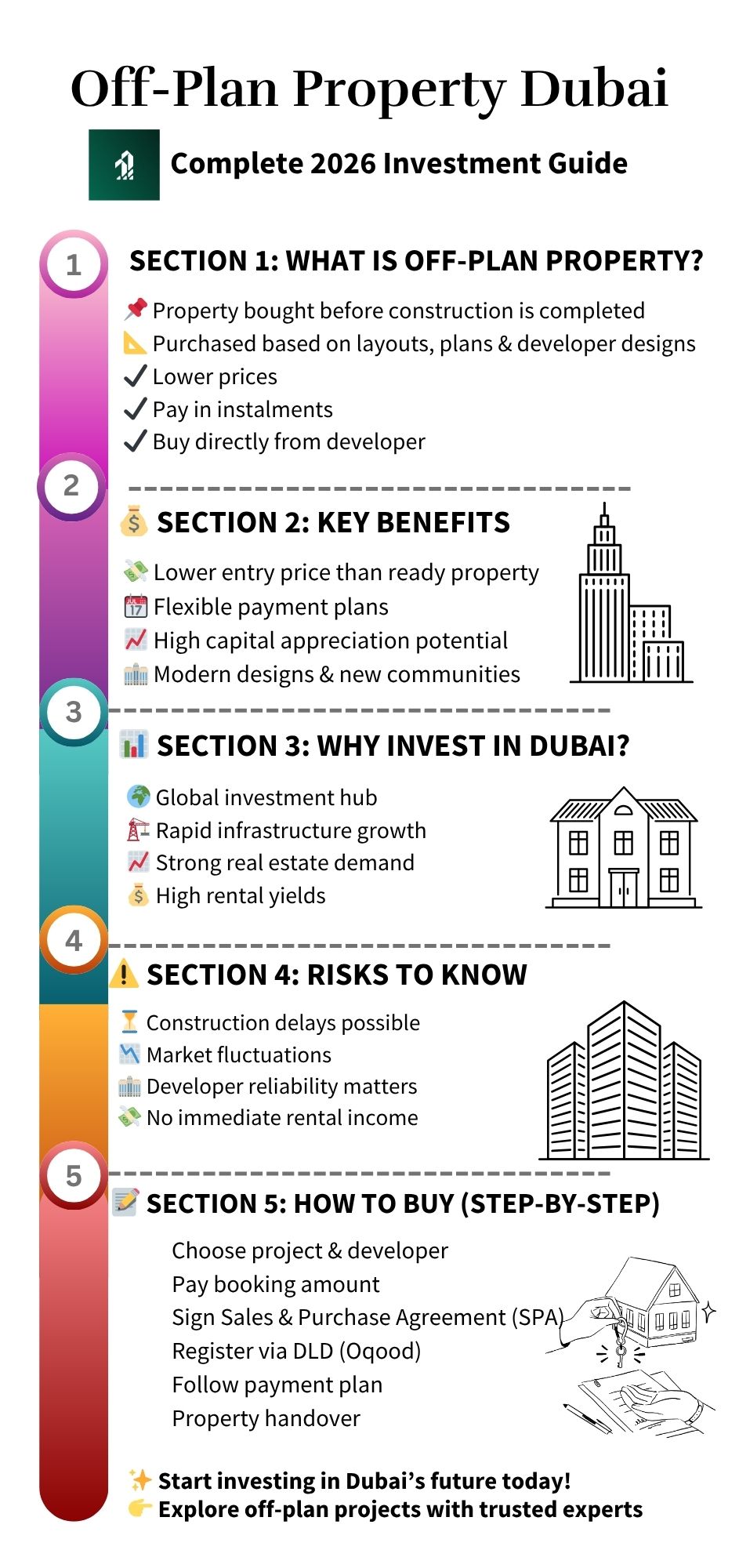
The Rewards, and the Catch Behind Each One
Lower Entry Prices and Flexible Payment Plans
Off-plan homes are often priced below comparable ready units, and payment is spread across the construction period instead of paid all at once. For many buyers that makes a purchase possible that would otherwise be out of reach. The size of the discount varies from project to project and can narrow when demand is strong, so treat any headline figure with care.
The catch is that instalments are firm commitments. The total price does not shrink because the payment plan is friendly, and you may pay for a long time before you have a home to live in or rent out. Plans that extend past handover add to your obligations after the building is finished.
More Choice and Newer Specifications
Buying early gives you a wide selection of new launches, modern layouts, contemporary amenities, and often the chance to pick your preferred floor and orientation before the best units go.
The catch is that you are choosing from plans, renders, and a show apartment, not the finished home. Finishes, views, and surroundings can differ from what you imagined, especially if neighbouring plots are still to be built.
Potential for Price Growth Before Handover
Some buyers who entered at launch in earlier years saw values rise by the time their buildings completed, and that history is a big part of off-plan’s appeal.
The catch is that this is never guaranteed, and market commentary suggests conditions have become more selective. Where many similar units are due to complete in the same area, values can be flat, and any launch premium can fade at handover. Treat price growth as a possible upside, not a plan you can bank on.
Buyer Protections Built Into the System
Dubai has a strong framework for off-plan buyers. Projects must be registered with the Dubai Land Department, buyer payments are meant to go into a dedicated escrow account with funds released against construction milestones, and your purchase is recorded on the Oqood interim register.
The catch is that these protections reduce the risk of money being misused, but they do not guarantee on-time delivery or a rising price. You should still verify the project and escrow details yourself on the Dubai REST app before you pay anything.
The Risks Worth Taking Seriously
Delays and Changes to the Project
Construction timelines can slip. Sales and purchase agreements commonly include a grace period beyond the stated completion date, often cited as somewhere in the range of six to twelve months, though the exact terms vary by contract. Read the delay clause carefully, because it determines when you can act if a project runs late. A delay also pushes back the date you can move in or start earning rent.
The Market Can Move Against You
Dubai has a large pipeline of new homes, and published estimates of how many will be delivered vary widely. What matters more than any single figure is where the supply is concentrated. If many similar units complete in the same community around the same time, rents and resale prices can soften locally, even when the wider market is healthy. Buyer confidence can also shift with broader events, so a purchase priced in one market can complete in another.
No Rental Income While You Wait
While you wait for handover, you are paying instalments and earning nothing. If you are also renting a home in the meantime, the carrying cost is real. Once the building completes, service charges begin, and any rental figure quoted in a brochure is a projection until real tenants are in place.
Fewer Exits Than People Assume
Many buyers assume they can sell before completion whenever they like. In practice, many developers only allow resale once a portion of the price has been paid, with figures of 30 to 40 percent often mentioned, though this varies by developer, and transfer fees can apply. Reports also suggest that pre-handover resale has become harder than it was in some earlier years. Plan on the assumption that you may need to hold until handover.
How to Reduce the Risks
None of these risks is a reason to avoid off-plan altogether, but each is worth managing.
- Choose the developer carefully. Look at their record of delivering previous projects on time and to the promised standard.
- Verify the project and the escrow account on the Dubai REST app, and pay only into the verified escrow account.
- Read the sales and purchase agreement in full, including the delay clause, the payment schedule, and what happens if you miss a payment.
- Compare the price per square foot against nearby ready homes and other launches, so you know what the discount really is.
- Stress-test your plan. Ask whether you could comfortably keep paying if handover slipped by a year.
- Keep a cash buffer for fees, service charges, and furnishing, so you are not stretched at the finish line.
- Base your rent estimate on real listings in comparable buildings, not on the brochure.
What to Look for in Off Plan Properties for Sale
Once you understand the trade-offs, a few features help separate a strong project from a merely attractive one.
- Location fundamentals. Look at access to transport, schools, workplaces, and any amenities that already exist, not only those promised.
- How much is being built nearby. A lot of similar supply arriving at once can weigh on both rents and resale values.
- The unit itself. Check the floor plan, the internal area, the view, and the balcony, and ask what could be built in front of it.
- The payment plan. Understand exactly how much you pay when, and whether any payments fall after handover.
- The handover date. Ask what has been built so far, and what your options are if the date slips.
- Estimated service charges. These affect your net return and vary widely between projects.
You can browse current launches on our off-plan properties page, read our explainer on how off-plan works, or see the developers whose projects appear on our site.
Who Off-Plan Suits, and Who Might Prefer a Ready Home
Off-plan tends to suit buyers with a long time horizon, a comfortable budget for instalments, and patience to wait for handover. It can also appeal to people who want a brand-new home with modern amenities and are happy to plan around a construction timeline.
It may be less suitable if you need to move in or earn rent soon, if uncertainty makes you uncomfortable, or if your plan depends on selling quickly before completion. A ready home costs more upfront in many cases, but it lets you see exactly what you are buying, verify the actual rent, and avoid construction risk. Our investors guide is a helpful place to compare the two routes.
Questions to Ask Before You Commit
- What is the developer’s record on previous projects, including delivery dates?
- What is the project’s registration number, and which bank holds its escrow account?
- What is the full payment schedule, and what falls due after handover?
- What does the agreement say if handover is delayed?
- What are the estimated service charges once the building is complete?
- What are the resale rules if I want to sell before handover?
- How much comparable supply is due to complete nearby?
FAQs
Is off-plan riskier than buying a ready home?
Generally it carries more timeline and market risk, because you are buying something that is not yet built. It also offers advantages such as payment plans and, often, lower entry prices. Whether it is right depends on the project and on your circumstances.
What happens if the developer delays handover?
It depends on the terms of your agreement, including any grace period. Read the delay clause before you sign, and take independent legal advice if you are unsure how it applies to your situation.
Is my money protected if a project runs into trouble?
Dubai’s escrow system is designed to protect buyers’ payments by holding them in a project-specific account and releasing them against construction milestones. How a particular situation plays out depends on the circumstances and your contract, so verify the project’s registration and escrow details before you pay.
Can foreigners buy off-plan property in Dubai?
Yes. Foreign nationals can buy freehold property in designated zones, including many off-plan projects, with full ownership rights and without needing UAE residency.
Can I sell before handover?
Often yes, but it is subject to the developer’s rules, which commonly require a share of the price to be paid first and may involve fees. Ask about the resale terms before you buy, not after.
Ready to Weigh Your Options?
If you are comparing off plan properties for sale and want a straight conversation about the risks as well as the rewards, the Takween Aldar team is happy to help you shortlist projects, compare payment plans and handover dates honestly, and understand the full cost before you commit. Visit takweenaldar.ae or schedule a free consultation and tell us what you are looking for.